
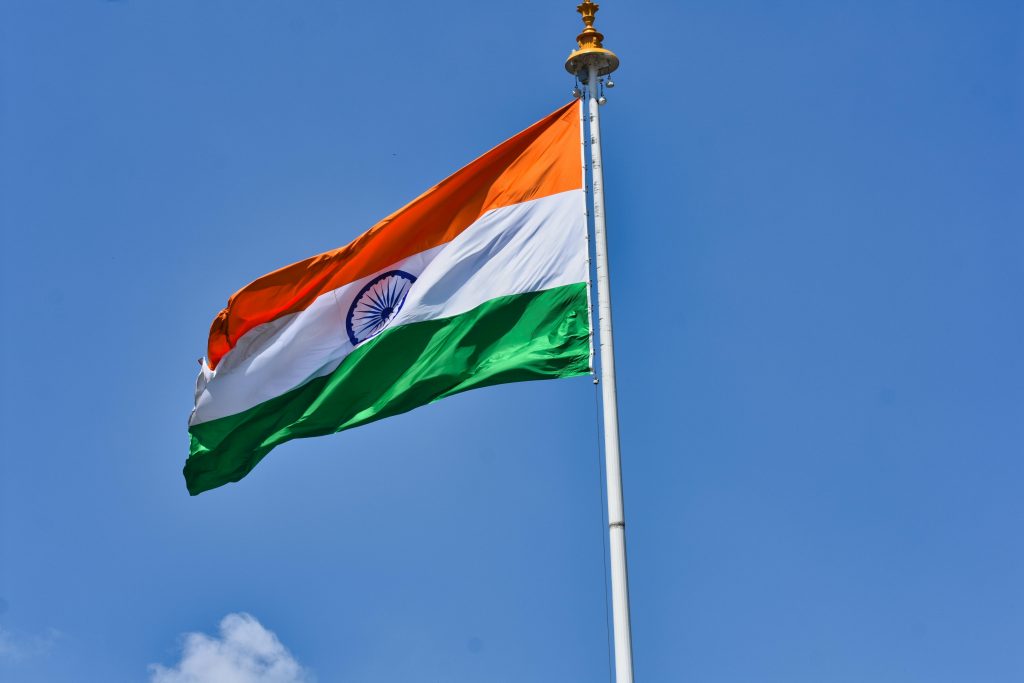
The Flag represents a nation’s identity. It is a symbol of the nation’s respect and pride. The citizens of India show their tremendous love and respect towards the nation on 15th August and 26th January by proudly displaying the Tiranga wherever they can. Unfortunately, this pride is short-lived! In the evening, the same Flags are seen lying in garbage bins or sewage pipes, we find these Flags getting trampled upon on the roads. People forget that this is insulting to the Flag. Often, these Flags are burnt with garbage. Every citizen must maintain proper respect towards our National Flag. For over two decades, the Anjani Putra Sena (APS) has been using various media to create awareness about the ‘Respect National Flag’ campaign. Due to untiring efforts, APS has succeeded in ending 95% production of plastic National Flags, and the subsequent denigration of the Flag.
The Flag Code Simplified For You
- Do’s (✓)
- The Flag should always occupy a position of honour and be distinctly placed.
- Always hoist the flag briskly and lower it slowly and ceremoniously.
- Hoist the Flag at a height and in a suitable manner.
- Stand at attention facing the flag during the ceremony of hoisting or lowering of the flag.
- Take care to see that the Flag does not get crumpled.
- Take care to see that the National Flag is not trampled upon or torn.
- Dont’s (✗)
- Do not let children use the National Flag as a toy.
- Do not buy or use plastic Flags.
- Do not use paper Flags to pin up on shirt pockets, etc.
- Do not use the Flag as a banner or for decoration.
- Do not let the Flag fall on the ground.
- Do not use the Flag as a costume or uniform.
Examples of the Flag dishonoured
If you find any person or entity disrespecting the National Flag, make them aware of it or register a complaint against them promptly. Remember, it is an offence that is punishable by a jail term!

Note: These photos have been posted to create awareness and not by any means to hurt sentiments.
- Ensure that the Flag is not draped over any vehicle
- Ensure that the Flag is not used as a curtain
- Ensure that nothing is written or printed on the National flag
- Ensure that the Flag is not printed on any apparel or handkerchiefs, masks, napkins, cushions, doormats, etc.
- Ensure that the flag is not used as a drapery in any form whatsoever
- Ensure that the National Flag is not crumpled or trampled upon or torn
- Ensure that the Flag is not used in any form of advertisement or that any advertisement is tied to the flag pole
- Ensure that spoilt Flags are collected and given to the administration to be respectfully disposed off
History of the Indian National Flag since Pre-independence period
Every free nation of the world has its own flag. It is a symbol of a free country. The National Flag of India was adopted in its present form during the meeting of Constituent Assembly held on the 22 July 1947, a few days before India’s independence from the British on 15 August, 1947. It served as the national flag of the Dominion of India between 15 August 1947 and 26 January 1950 and that of the Republic of India thereafter. In India, the term “tricolour” refers to the Indian national flag.
The National flag of India is a horizontal tricolor of deep saffron (kesari) at the top, white in the middle and dark green at the bottom in equal proportion. The ratio of width of the flag to its length is two to three. In the centre of the white band is a navy blue wheel which represents the chakra. Its design is that of the wheel which appears on the abacus of the Sarnath Lion Capital of Ashoka. Its diameter approximates to the width of the white band and it has 24 spokes.
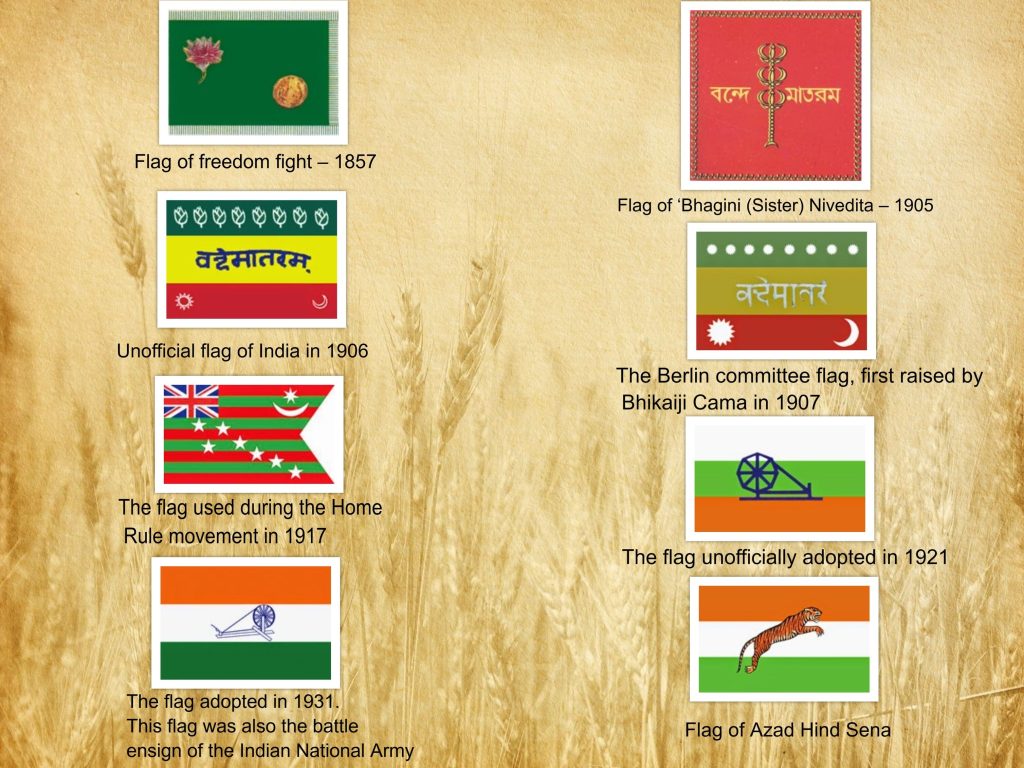
Evolution of the Tricolour
t is really amazing to see the various changes that our National Flag went through since its first inception. It was discovered or recognised during our national struggle for freedom. The evolution of the Indian National Flag sailed through many vicissitudes to arrive at what it is today. In one way it reflects the political developments in the nation. Some of the historical milestones in the evolution of our National Flag involve the following:
These flags are shown here so that people know the history of India on the occasion of Independence Day and they note the diversity in various flags.
Official flag of independent India
On July 22, 1947, the Constituent Assembly adopted it as Free India National Flag. After the advent of Independence, the colours and their significance remained the same. Only the Dharma Charkha of Emperor Asoka was adopted in place of the spinning wheel as the emblem on the flag. Thus, the tricolour flag of the Congress Party eventually became the tricolour flag of Independent India.
Colours of the Flag
In the national flag of India the top band is of Saffron colour, indicating the strength and courage of the country. The white middle band indicates peace and truth with Dharma Chakra. The last band is green in colour shows the fertility, growth and auspiciousness of the land.
The Chakra
This Dharma Chakra depicted the “wheel of the law” in the Sarnath Lion Capital made by the 3rd-century BC Mauryan Emperor Ashoka. The chakra intends to show that there is life in movement and death in stagnation.


